I Did Fourteen Months of Ab Work for a Stomach That Was Never Going to Respond. A Pelvic Floor PT Finally Told Me Why.
The fold above my scar was not fat, and it was not my abs. It was something underneath, and nobody had mentioned it once in fourteen months.

My daughter was fourteen months old the day I finally put on the jeans.
Not the maternity ones.
The dark wash high rise pair I bought in 2023 and kept in the back of the closet like a receipt I was going to redeem.
They zipped. I remember being surprised that they zipped.
Then I turned sideways.
There was a fold of skin sitting on top of the waistband.
Not spilling over the way a waistband can. Folding, like a page turned down.
It started right at the scar line and it stayed there whether I stood up straight or sucked in or did anything at all.
I took the jeans off. I did not go out that night.

Fourteen Months of Doing the Wrong Thing Correctly
Here is what I want you to understand about that fourteen months.
I was not lazy about it.
I did a postpartum core program, the paid one, four days a week from month three.
I bought the recovery leggings that everyone in my mom group swore by; ninety two dollars, and I wore them daily.
I bought a waist trainer in month seven and wore it under work clothes until it left marks.
I got back under my pre pregnancy weight in month nine.
I want to say that again, because it is the part that broke something in me. I hit the weight and the fold was still there.
That was when I stopped telling myself it was fat.
I did not replace that belief with a better one.
I just moved to a worse one, which was that my body had been permanently rearranged and the only fix was the fifteen thousand dollars I did not have.
The Appointment I Almost Cancelled
I went to a pelvic floor physical therapist for something else entirely.
Leaking when I sneezed, which is its own article.
She asked to look at the scar. Not the fold. The scar.
She put two fingers flat on the line and asked me to lift my head off the table.
Then she tried to slide the skin above the scar side to side, the way you would slide a rug across a floor.
It did not slide. On the left half it moved maybe a centimeter, and on the right it did not move at all.
She asked if that felt tight and I said it always feels tight, and she said that is the thing nobody told you.

"You have been training the muscle underneath a scar that is glued down. The muscle is fine. The skin above it is fine. The problem is the seam between them."
What Is Actually Happening Under That Fold

A cesarean cuts through several layers. Skin, fat, fascia, muscle wall, uterus.
Each layer gets closed separately and each layer heals separately.
When those layers heal well, they stay separate. They glide against each other when you move, the way they did before surgery.
When they do not heal well, they heal stuck to each other.
Physical therapists call it a scar adhesion. One layer seals to the layer beneath it when it was supposed to slide freely.

That is the fold. It is not a fat deposit and it is not a muscle failing to hold. It is soft tissue draping over a line that has been tacked down to the layers underneath.
Why crunches were never going to touch it
Muscle separation, called diastasis recti, is a real and separate condition.
Core work genuinely helps it.
But muscle separation is a midline problem that runs vertically up your abdomen, and it does not by itself create a fold sitting right on a horizontal scar.
One plastic surgeon puts it plainly: a C-section shelf is neither purely fat nor purely muscle, and this is why weight loss or core exercise often has little effect on the shelf itself even when overall abdominal tone improves.
It is also why slim, fit women still have one. I have a friend who ran a half marathon eleven months postpartum.
She has the same fold I do.


"The first thing I check on a cesarean scar is whether it moves.
Not how it looks. Whether it moves.
A scar that will not glide is pulling on everything attached to it."
"Patients come in having done six months of core work and they are frustrated with themselves.
They should not be. They were working the right muscle underneath the wrong problem."
"I want the scar soft before I ask it to move.
Dry, stiff scar tissue does not respond to mobilization the way hydrated tissue does."
Why the Scar Stays Firm Instead of Softening
Here is the part that actually changed what I did.
A healing scar does not have a finished outer layer of skin yet.
The barrier that normally holds water in your skin is not built properly in scar tissue, so the scar loses moisture much faster than the skin around it.
Researchers measure this and call it transepidermal water loss.
Your body reads that water loss as a wound that is still open.
So it keeps sending the repair signal.
Cells called fibroblasts keep laying down collagen, long past the point where the actual repair is done.
The extra collagen is what makes a scar sit raised, feel ropey, and stay stiff instead of relaxing into the skin around it.

A stiff anchored scar holds the fold. A soft pliable scar does not hold it the same way.

The Two Things She Told Me to Do
She gave me scar mobilization work.
Fingers flat, small circles directly on and around the line, then lifting and rolling the tissue once it tolerated it.
Five minutes, twice a day. I will be honest that the first week felt strange and slightly awful.
And she told me to keep the scar itself soft while I did it, because working on tissue that is dried out and stiff is working against yourself.
For that second part she said medical grade silicone sheets.
Not a cream. Not an oil.
Sheets.

Why Sheets and Not the Bio-Oil in My Bathroom
I had Bio-Oil. I had the Mederma tube from month two.
I asked her what was wrong with them.
Nothing is wrong with them, she said. They are just not doing the job you think they are doing.
An oil or a cream sits on top and absorbs.
It hydrates for a while and then it is gone, and it never forms a barrier that holds moisture in.
A silicone sheet does something different. It seals the scar under a soft flexible layer and keeps the water in the tissue.
One controlled comparison found silicone sheets to be far more occlusive than fluid gels or hydrating creams, reducing water loss below the level of normal skin.
Gels and creams did not come close.
Stop the water loss and you stop the false alarm.
Stop the false alarm and the collagen overproduction slows down.
What the guidelines actually say
Silicone sheeting is named the first line non invasive option for scar prevention and treatment in the international clinical recommendations on scar management, updated in 2014 and published in Dermatologic Surgery.
The Cochrane review on silicone gel sheeting, covering twenty trials and 873 people, found reduced hypertrophic scarring in scar prone people.
Those reviewers rate the certainty of that evidence as low, and it is worth knowing what that actually means.
It is a verdict on the trials, not on the material.
Most were small, few were properly blinded, and systematic reviewers want larger and better run studies before they call anything settled.
So both things are true at once.
The mechanism is well understood, the guidelines put silicone first, and the trial quality sitting underneath those guidelines is thinner than most people assume.
What silicone is not is a contour treatment. It works on the scar.
It does not remove skin and it does not repair muscle separation.
The Ones I Ended Up Using
I bought three brands before I settled.
The first was a cheap roll from Amazon, fourteen dollars, and it curled off the edges by lunch.
The second was a name brand from the pharmacy that cost more than I want to admit and came off in the shower on day two.
I have since learned this is the single most common complaint in the whole category.
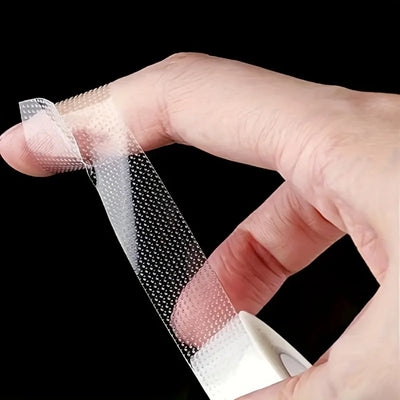
The ones I use now are the Nedd Innovations Strong Adhesive sheets.
The adhesive is the reason, and it is not a small thing.
A silicone sheet only works while it is sealed against the skin; a sheet that lifts at the corners has stopped treating anything.


What Changed, and What Did Not
I want to be careful here, because I read a lot of pages that were not careful with me.


It was week eleven, on an ordinary Tuesday.
I was getting dressed for work and I pulled my waistband up over the scar without thinking about it.
For fourteen months I had done that same movement carefully.
Two fingers to hold the fabric off the line, lift, then let go.
I never once decided to do that. I had just been doing it, every morning, for over a year.
That is what the change actually felt like. Not a photograph.
A thing I used to brace for and then did not have to brace for.

I put the dark wash jeans on again in October.
I turned sideways. Of course I turned sideways.
The fold is still there.
It is smaller than it was, it sits differently, and the line underneath it does not catch when I move.
The fold is better. It is not gone.
My skin still stretched through a pregnancy and a surgery, and no sheet is going to un-stretch it.
What changed is that the line underneath is soft and mobile instead of stiff and tacked down, and the tissue above it drapes differently because of that.
If a page promises you the fold will disappear from a sheet alone, close the page.
Why the Tape Matters More in Week Two Than Week One
Here is something nobody tells you about silicone sheets. The silicone does not wear out. The adhesive does.
Every hour you wear a sheet it picks up skin oil.
Every time you wash it, a little more of the tack goes down the sink with the dirt.
Somewhere around day ten to fourteen the edges stop gripping, a corner starts lifting by mid afternoon, and that is the point where most people throw the sheet away and open a new one.
But look at what has actually failed there.
The silicone is inert.
It has not broken down, it has not lost anything, and it will still hold a seal against your skin exactly as well as it did on day one. The only thing that stopped working is the sticky layer on the back.
So you do not need a new sheet. You need a different way to hold the old one down.

That is the entire reason a roll of breathable medical tape comes in the box.
One strip along each long edge pins the sheet flat and restores the seal.
The occlusion runs again, and the silicone carries on doing what it was always still capable of doing.
The middle is left bare on purpose.
The silicone has to touch the scar to work, so the tape frames it rather than covering it.
And because the tape is a breathable grid rather than a solid plastic film, nothing gets trapped underneath and the skin around the scar keeps breathing.
It also works the other way round.
Taping the edges from day one keeps fabric from dragging at them, which is what strips the tack in the first place.
Used early it slows the wear. Used late it replaces it entirely.


Who This Is Actually For
- Your fold sits directly on the scar line and did not move with weight loss.
- Your scar still feels tight, ropey, itchy or numb.
- The line still looks red, purple or darker than the skin around it.
- Your scar catches on waistbands and underwear.
- You did the core program and it did not touch the fold.
- You want abdominal contour change. That is a different conversation with a different professional.
- Your incision is still open, weeping or crusting. Wait until it is fully closed.
- Your main issue is midline muscle separation. See a pelvic floor PT first.
- You want a result this month. The honest window is eight to twelve weeks.
Questions I Had
A production run came back from the factory with EXP 10/25 stamped on the outer carton.
That date is a printing error.
It is not the date the product was made and it is not a date anything inside stops working.
Here is the part that matters. Medical grade silicone is an inert, stable material. It is not a cream, it has no active ingredient, and there is nothing in it to spoil or lose potency.
The sheets inside these boxes are the same sheets we sell at full price in undamaged cartons.
But a pharmacy will not put a box on a shelf with a date that has already passed printed on it, and neither would we sell it as new stock at $83.31.
So the entire run is going out as buy one get one free, with a roll of medical tape in every order, until it is gone.
When this run is finished, the price goes back to $83.31. There is no second batch of misprinted boxes waiting behind it.
This is one run of stock with one bad print, and the discount exists for exactly as long as the pallet does.
Strong Adhesive Silicone Scar Sheets
Every option below is buy one get one free. Choose how many sets you want.
What Other Moms Have Said

Second cesarean and this scar was worse than the first one.
Eleven weeks in and it is flat enough that I stopped thinking about it when I get dressed.
The sticking is the part that surprised me; I have thrown away two other brands that came off in the shower.

My scar is three years old and I assumed that ship had sailed.
It is softer. It is not gone but it is softer, and it does not pull when I stretch.
I wish I had started at three months instead of three years.

Four stars because the first two days my skin was a little pink around the edges.
I dropped down to four hours a night for a week and built back up, and it has been fine since.
Week seven and the colour has really come down.

I am eighteen months out from an emergency cesarean and the line was still raised and darker than everything around it.
Nine weeks of wearing it overnight and the colour has come down more than anything else I tried.
It stays on under my scrubs all day.

What sold me was that it does not print through leggings.
I wore the pharmacy ones once under gym kit and you could see the outline.
These I forget are on.

Works, but you have to actually wash it every day or it stops gripping by about day four.
Once I got into that habit a single sheet lasted me the full two weeks.


About this article: The Wellness Tech Report is the editorial arm of Nedd Innovations and this article discusses a product we sell. Dr. Okonkwo is a paid consultant. Individual results vary. This is not medical advice. Talk to your doctor or a qualified physical therapist about your own recovery.